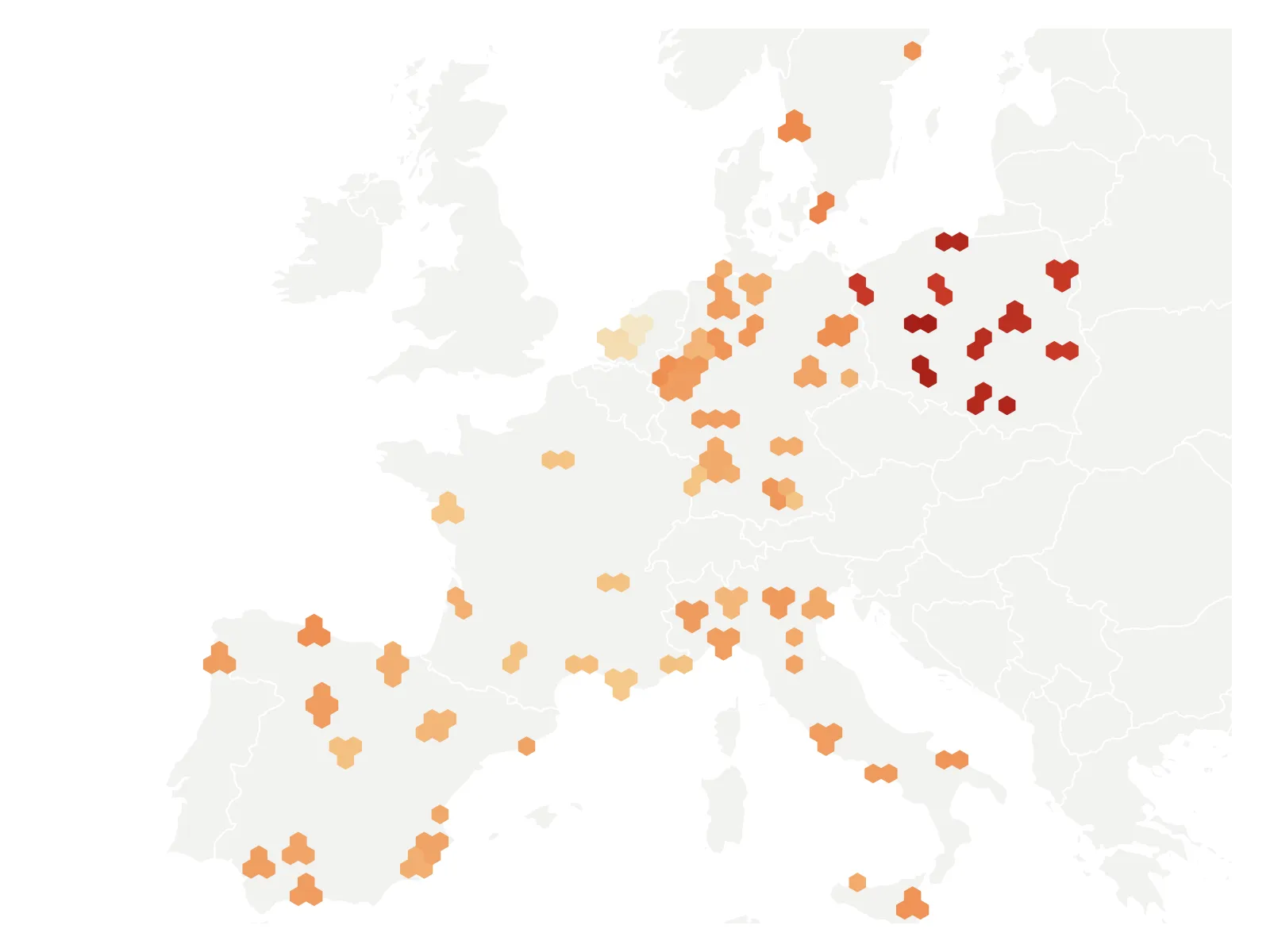
Where Amazon pickup runs thin in Europe
Amsterdam has one Amazon pickup point for every 14,790 residents, against 480 in Poznań. The Netherlands and France have Amazon’s thinnest large-city coverage.
Ernesto Kufoy · · 3 min read
Key findings
- 01The four large Dutch cities are the thinnest in mainland Europe, each with one Amazon pickup point for every 7,480 residents or more.
- 02All but one of France’s large cities rank in the bottom 15, including Paris, Lyon, Marseille and Toulouse.
- 03Munich has half of Berlin’s Amazon pickup density.
- 04Outside the Netherlands, Paris and Madrid are the thinnest-served capitals we track.
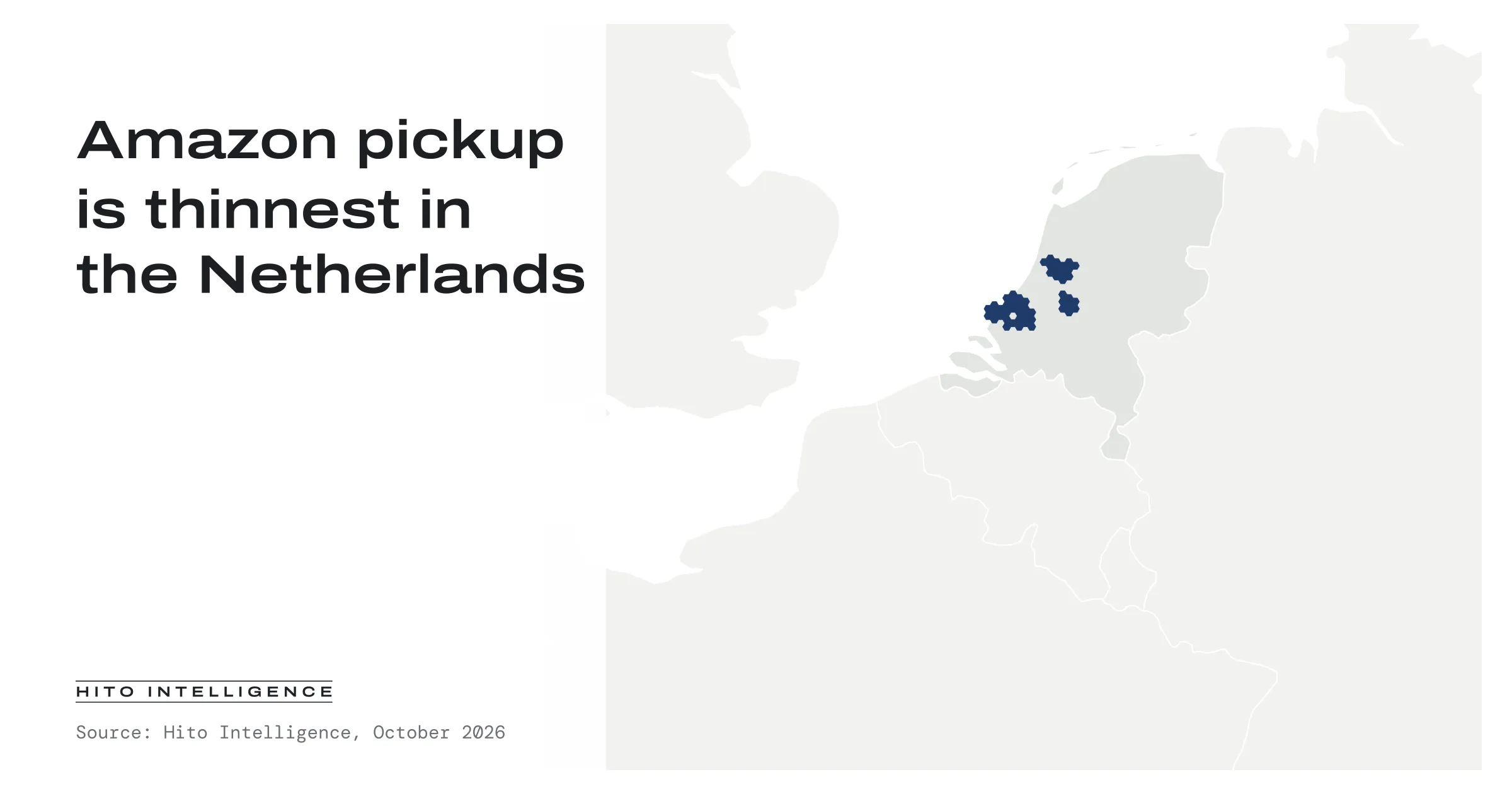
Amsterdam has one Amazon pickup point for every 14,790 residents. Poznań, Amazon’s best-served large city in Europe, has one for every 480. Outside the Netherlands, Amazon’s thinnest large-city coverage is in France.
Which large cities have the fewest Amazon pickup points per resident?
Among large mainland cities in the EU countries where we track Amazon, these have the fewest Amazon pickup points per resident:
| Rank | City | Country | Residents per Amazon pickup point |
|---|---|---|---|
| 1 | Utrecht | Netherlands | 14,900 |
| 2 | Amsterdam | Netherlands | 14,790 |
| 3 | Rotterdam | Netherlands | 8,040 |
| 4 | The Hague | Netherlands | 7,480 |
| 5 | Marseille | France | 2,520 |
| 6 | Nantes | France | 2,420 |
| 7 | Munich | Germany | 2,320 |
| 8 | Toulouse | France | 2,320 |
| 9 | Strasbourg | France | 2,300 |
| 10 | Paris | France | 2,300 |
| 11 | Lyon | France | 2,280 |
| 12 | Nice | France | 2,270 |
| 13 | Madrid | Spain | 2,220 |
| 14 | Montpellier | France | 2,190 |
| 15 | Zaragoza | Spain | 1,960 |
UK cities are not included in this ranking. Belgium and Luxembourg are also left out, since we do not yet track Amazon pickup there. Island cities are excluded too: Las Palmas de Gran Canaria and Palma de Mallorca have thin Amazon coverage, but island logistics make them a different case from mainland cities.
Why is the Netherlands so far behind?
The Netherlands is the thinnest Amazon market we track by a wide margin. Across its large cities there is one Amazon pickup point for every 10,240 residents, about seven times the German level. Dutch shoppers lean on national parcel networks, which this analysis does not cover.
Timing helps explain the gap. Amazon only opened a dedicated Dutch store, amazon.nl, in March 2020, its sixth in Europe, entering a market where bol.com was already the leading online retailer (DutchNews). Its Dutch pickup network has had far less time to grow than its German or French ones.
Why does France trail?
Across France’s large cities there is one Amazon pickup point for every 2,300 residents, the thinnest of Amazon’s large EU markets. France also has strong national pickup-point networks of its own, so Amazon’s lighter footprint there likely reflects competition rather than an absence of pickup options.
Regulation shapes the French offer too. French law sets a minimum delivery fee on new books, and in 2026 Amazon stopped offering free book delivery to its French lockers after a dispute with booksellers, while keeping it at staffed pickup points (Connexion). Most of what Amazon offers French shoppers is partner pickup points rather than its own lockers.
Why do Germany’s biggest cities trail Berlin?
Berlin has one Amazon pickup point for every 1,160 residents. Munich has one for every 2,320, exactly half Berlin’s density, and Münster and Bonn sit near 1,940. Amazon has built a much denser network in Berlin and the Ruhr than in Germany’s south.
Where is the white space?
Outside the Netherlands, the clearest gaps are France’s large cities and Germany’s south. Marseille, Nantes and Toulouse each have around one Amazon pickup point for every 2,300 to 2,500 residents, roughly half the density of Berlin. Those are large, dense markets where Amazon’s own network is comparatively light.
We are adding more European networks next, which will show whether these cities are underserved or simply served by someone other than Amazon.
Get the city-level data
This post covers large cities. Behind it is every municipality in our European data, with Amazon pickup points per resident and the mix of lockers, counters and partner points.
- Locker operators and carriers: find the large cities where Amazon is thin.
- Investors and analysts: track how pickup networks change, quarter by quarter.
- Retailers: see how pickup access compares across your markets.
Sources
- Hito Intelligence, October 2026
- Eurostat GISCO, Local administrative units, 2021 boundaries and population
- Amazon launches dedicated Dutch service with ‘thousands’ of retailers, DutchNews
- Amazon drops free book delivery to its lockers in France, Connexion
About the data
This analysis draws on the Hito Intelligence location record. Every location carries the dates it was first and last observed, reconciled across multiple sources.
location_id · network · first_seen · last_seen
Request a sample →Found this useful? Share it.